Knowledge Graph Construction
Code for entity recognition, entity linking, and relation extraction on news and clinical text.
Read the online documentation for the user guide and API reference.
See SETUP.md for installation, data downloads, model paths, and parameter examples.
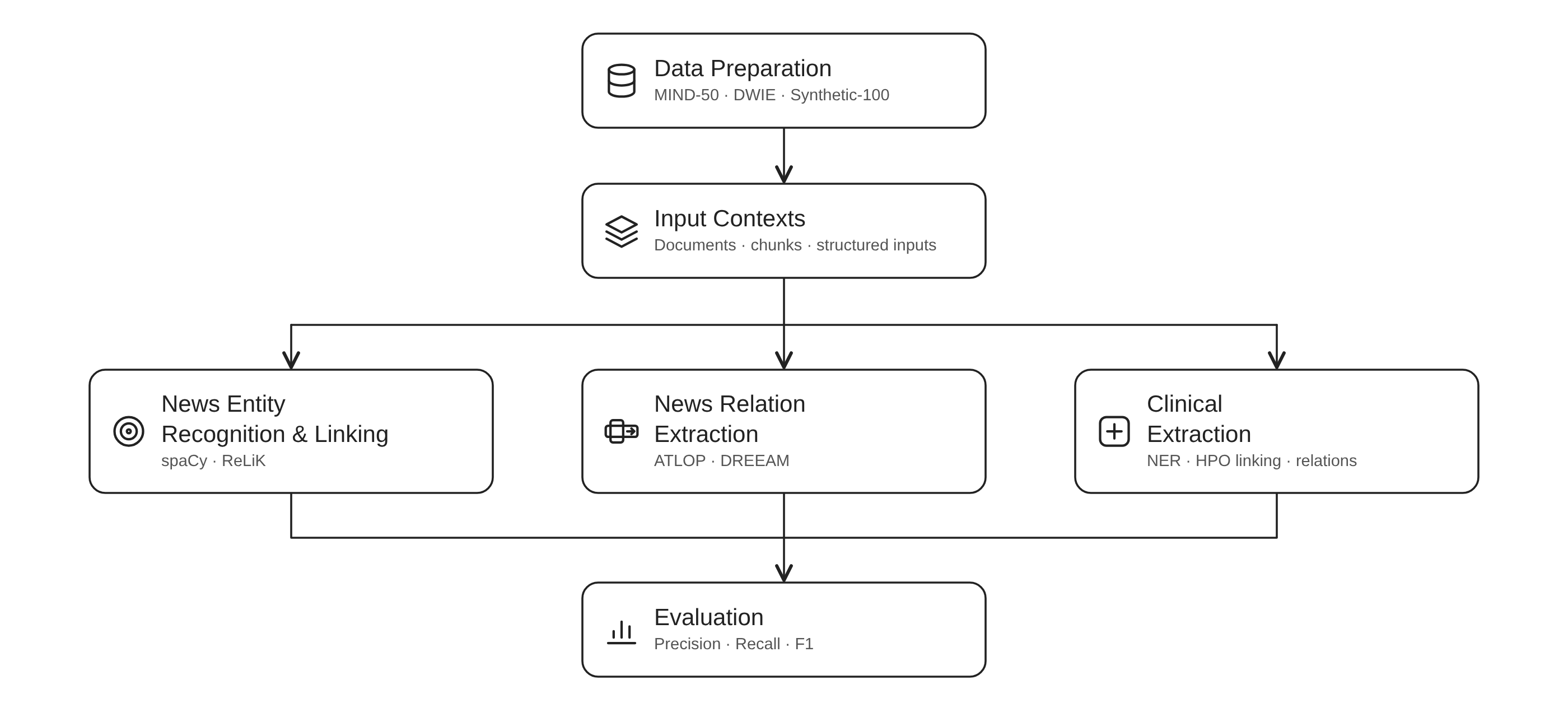
The experiments study how input boundaries affect extraction: whole articles, predicted topic segments, fixed-length chunks, sentences, and clinical blocks and sections.
- News: MIND-50 and DWIE, using spaCy with spaCy-entity-linker, ReLiK, ATLOP, and DREEAM.
- Clinical: Synthetic-100, using GLiNER-Relex, HunFlair2, MedCAT, PhenoBERT, FastHPOCR, SapBERT, and GLiREL.
News segmentation uses the model from topic_segmentation/. Clinical experiments use the reference blocks and sections supplied with the notes.
Quick start
Follow installation and place the MIND-50 files in data/mind50/. Then run spaCy from the repository root:
cd knowledge_graph
source scripts/activate.sh

python -m knowledge_graph.news.entity_linking --backend spacy \
    --input data/mind50/mind_nerl_gold_qid.json \
    --out runs/news/example/spacy_document.json
This example runs on CPU. The linker downloads its Wikidata database on first use.
Run the remaining commands from knowledge_graph/, with the environment activated. Add --help to a Python command to see its options.
Extract entities and links from your own articles
Save a JSON object containing documents, with an id and text for each article:
{"documents": [{"id": "article_1", "text": "Microsoft opened an office in Zurich."}]}
Use spaCy with spaCy-entity-linker:
python -m knowledge_graph.news.entity_linking --backend spacy \
    --input articles.json --out runs/news/articles_spacy.json
Or ReLiK, which requires a CUDA GPU:
python -m knowledge_graph.news.entity_linking --backend relik \
    --input articles.json --out runs/news/articles_relik.json
The output contains the input documents and their entities with character offsets (begin, end): spaCy entities carry Wikidata IDs (wikidataId), ReLiK entities Wikipedia titles (wikipedia_title).
To process predicted topic segments, add --segments predictions.jsonl. The segmentation output must use the same article IDs.
See Code structure for Python usage and adapter interfaces.
Reproduce the thesis experiments
Run from knowledge_graph/ with the environment activated and data and weights in place. To prepare inputs, run the saved news models, and score their predictions:
bash scripts/news.sh all runs/news/rerun
To include ATLOP and DREEAM training:
bash scripts/news.sh reproduce runs/news/rerun
The pipeline writes inputs, predictions, and scores under the selected output directory. reproduce uses the models trained there; all uses the saved weights in runs/news/fixed/docre_models/.
See individual stage commands for news stages and clinical NER, HPO linking, and relation extraction. Clinical experiments share an 80/10/10 split of Synthetic-100 and compare released and adapted models on the ten test notes.
Folder structure
knowledge_graph/
├── scripts/                    # environment and news pipeline
├── src/knowledge_graph/
│   ├── news/                   # news data, extraction, training, and scoring
│   ├── clinical/               # clinical data, extraction, training, and corpus construction
│   ├── common.py               # shared I/O, metrics, and checkpoint selection
│   └── paths.py                # dataset and output locations
├── data/                       # datasets, annotations, and ontology resources
├── checkpoints/                # downloaded model weights
└── runs/                       # trained models, predictions, and scores
Third-party code
news/atlop.py: ATLOP; no license stated upstream.news/dreeam.py: DREEAM; MIT license.clinical/vendor/phenobert/: PhenoBERT with the bundled fastNLP components required by its released models; MIT license.
ATLOP and DREEAM provide the encoder, loss, and model code. Their shared feature preparation and batching are in news/docred.py.
Citations
@inproceedings{zhou2021atlop,
  author       = {Wenxuan Zhou and
                  Kevin Huang and
                  Tengyu Ma and
                  Jing Huang},
  title        = {Document-Level Relation Extraction with Adaptive Thresholding
                  and Localized Context Pooling},
  booktitle    = {Proceedings of the AAAI Conference on Artificial Intelligence},
  volume       = {35},
  number       = {16},
  pages        = {14612--14620},
  year         = {2021},
  url          = {https://ojs.aaai.org/index.php/AAAI/article/view/17717},
  doi          = {10.1609/aaai.v35i16.17717}
}

@inproceedings{ma-etal-2023-dreeam,
  author       = {Youmi Ma and
                  An Wang and
                  Naoaki Okazaki},
  title        = {{DREEAM}: Guiding Attention with Evidence for Improving
                  Document-Level Relation Extraction},
  booktitle    = {Proceedings of the 17th Conference of the European Chapter
                  of the Association for Computational Linguistics},
  pages        = {1971--1983},
  publisher    = {Association for Computational Linguistics},
  year         = {2023},
  url          = {https://aclanthology.org/2023.eacl-main.145/},
  doi          = {10.18653/v1/2023.eacl-main.145}
}

@inproceedings{orlando-etal-2024-relik,
  author       = {Riccardo Orlando and
                  Pere-Llu{\'i}s Huguet Cabot and
                  Edoardo Barba and
                  Roberto Navigli},
  title        = {{ReLiK}: Retrieve and LinK, Fast and Accurate Entity Linking
                  and Relation Extraction on an Academic Budget},
  booktitle    = {Findings of the Association for Computational Linguistics: ACL 2024},
  pages        = {14114--14132},
  publisher    = {Association for Computational Linguistics},
  year         = {2024},
  url          = {https://aclanthology.org/2024.findings-acl.839/},
  doi          = {10.18653/v1/2024.findings-acl.839}
}

@article{feng2022phenobert,
  author       = {Yuhao Feng and
                  Lei Qi and
                  Weidong Tian},
  title        = {{PhenoBERT}: A Combined Deep Learning Method for Automated
                  Recognition of Human Phenotype Ontology},
  journal      = {IEEE/ACM Transactions on Computational Biology and Bioinformatics},
  volume       = {20},
  number       = {2},
  pages        = {1269--1277},
  year         = {2023},
  url          = {https://doi.org/10.1109/TCBB.2022.3170301},
  doi          = {10.1109/TCBB.2022.3170301}
}

@article{ZAPOROJETS2021102563,
  author       = {Klim Zaporojets and
                  Johannes Deleu and
                  Chris Develder and
                  Thomas Demeester},
  title        = {{DWIE}: An entity-centric dataset for multi-task
                  document-level information extraction},
  journal      = {Information Processing and Management},
  volume       = {58},
  number       = {4},
  pages        = {102563},
  year         = {2021},
  url          = {https://doi.org/10.1016/j.ipm.2021.102563},
  doi          = {10.1016/j.ipm.2021.102563}
}

@inproceedings{DBLP:conf/acl/WuQCWQLLXGWZ20,
  author       = {Fangzhao Wu and
                  Ying Qiao and
                  Jiun{-}Hung Chen and
                  Chuhan Wu and
                  Tao Qi and
                  Jianxun Lian and
                  Danyang Liu and
                  Xing Xie and
                  Jianfeng Gao and
                  Winnie Wu and
                  Ming Zhou},
  title        = {{MIND:} {A} Large-scale Dataset for News Recommendation},
  booktitle    = {Proceedings of the 58th Annual Meeting of the Association for Computational
                  Linguistics, {ACL} 2020, Online, July 5-10, 2020},
  pages        = {3597--3606},
  publisher    = {Association for Computational Linguistics},
  year         = {2020},
  url          = {https://doi.org/10.18653/v1/2020.acl-main.331},
  doi          = {10.18653/V1/2020.ACL-MAIN.331}
}